Advertisement
The Rossellini twins are named Luca and Lorenzo. Their parents chose the matching L, matching Italian origin, and matching three-syllable rhythm on purpose. When people meet them, the response is always the same: oh, twins. That reaction is exactly what the Rossellinis wanted.
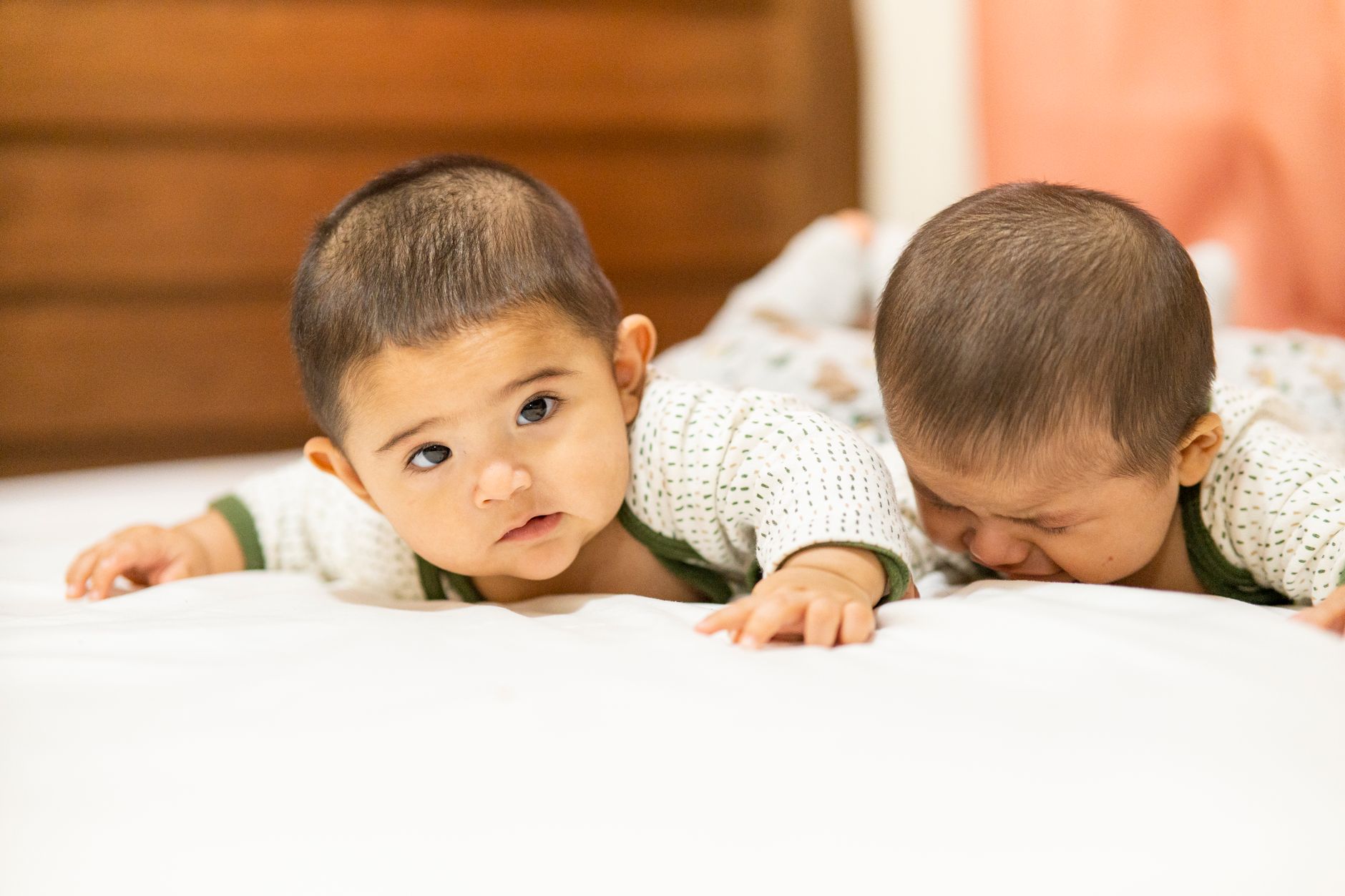
The Thibodeau twins are named Marc and Elise. Their parents chose independent names because they wanted the children to be recognized as individuals from birth. When people meet them, the response is often surprise: wait, they are twins? That reaction is exactly what the Thibodeaus wanted.
Advertisement
Twin and triplet naming is one of the few cases in baby naming where two opposite choices are both fully valid. This piece walks through the three main strategies.
Strategy one: matched names
Matched twin names share visible features. Common patterns:
- Same starting letter (Luca and Lorenzo).
- Same ending sound (Ella and Bella).
- Same syllable count and rhythm.
- Same cultural origin.
- Same length or same rare-versus-common status.
Matched twin names announce the twin relationship every time the children are introduced. Parents who like this outcome tend to like the visible bond. Kids raised in matched-name pairs often report that the matching became part of their identity and they liked it.
Strategy two: coordinated names
Coordinated names share a subtler feature than matched names. Common patterns:
- Related meanings (Aurora and Stella, both starlight references).
- Same era of origin (Ellis and Cora, both revival names).
- Related literary sources (Atticus and Scout, both from a single novel).
- Same register without matching letters or sounds.
Coordinated names read as a pair to families who share the reference. To strangers, they look like siblings, not necessarily twins. Coordinated names give the kids the option of matching or not matching depending on the context.
Strategy three: independent names
Independent twin names share nothing beyond the surname. Marc and Elise. Diego and Norah. Zara and James.
Independent names signal that the parents wanted the children to be individuals. The twin relationship is a fact, not a naming decision. Kids raised with independent names tend to report that they experienced their twinness through the relationship, not through the naming.
Comparison at a glance
| Strategy | Example | Reads as |
|---|---|---|
| Matched | Luca and Lorenzo | Coordinated twin identity, visible |
| Coordinated | Aurora and Stella | Themed but not overtly matched |
| Independent | Marc and Elise | Twin fact, individual identities |
Triplets: the pattern doubles down
Triplet naming intensifies the twin question because three matched names read louder than two. Three L-names becomes a family brand. Three coordinated names become a set that requires explanation. Three independent names sit as three separate people.
Common triplet patterns:
- Matched: Luca, Leo, Lorenzo. Reads as one visual decision.
- Coordinated: Aurora, Stella, Nova. All star references, no matched letters.
- Independent: Marc, Elise, and Owen. Three separate identities.
The overmatch risk is highest in triplets. Three rhyming names becomes a cliche fast. See the overmatch piece for the risks.
What the twins themselves prefer
Retrospective interviews with adult twins consistently show a split. Some twins with matched names loved the matching and would name their own twins the same way. Others with matched names disliked being read as a set and asked their parents to use full names professionally to differentiate.
Twins with independent names rarely wish they had been matched. Twins with matched names sometimes wish for more independence.
This suggests that when in doubt, independent is the safer default. Matched names should be chosen actively and not by pattern momentum.
The identical-versus-fraternal question
Identical twins face more identity conflation from strangers than fraternal twins. Identical twins with matched names amplify the conflation. Identical twins with independent names get help from the names to establish separate identities.
Fraternal twins already look different. Naming them matched or independent has less impact on outside perception.
Middle-name variations
A common compromise: matched first names with independent middle names. Luca James and Lorenzo Michael. The public introduction is matched. The paperwork and formal identity is individual.
The reverse also works: independent first names with matched middle names to signal the twin bond quietly. Marc Aurelius and Elise Aurelia. The middle names carry the twinship without dominating.
Worked example: the Chen triplets
The Chen family had triplets. Two boys and a girl. The parents started with the matched-name assumption because triplets seemed to demand it. Their first shortlist was Ethan, Evan, and Ella. All E-names. All two-syllable.
They read the set aloud twenty times over a weekend. It sounded like a brand. Ethan and Evan and Ella. The rhythm was identical. The children would be introduced as a chunk.
They pulled back to coordinated names instead. Ethan, Owen, and Nora. All two-syllable, all currently popular, all no matching letters. The set reads as three siblings born the same year without reading as three matching packages.
Related considerations
The sibling logic in the pillar applies to twins and triplets with extra weight because the children are the same age and always read as a set. The syllable-matching piece is especially relevant. For families with a strong cultural naming pattern, the continuity piece applies.
One practical detail for twins: hospital wristbands, birth-certificate paperwork, and pediatric records all rely on the first letter. If both twins share a first initial, expect a lifetime of mixed-up appointment reminders and school records. Some hospitals will label paperwork as "Twin A" and "Twin B" for the first few days as a safety net.
For triplets, add one more constraint: at least two of the three names should be immediately distinguishable across a room in an emergency. Matched sets sound charming but slow reaction time when a parent is trying to identify which child is crying. Prioritise clarity over symmetry.
Frequently Asked Questions
Is it wrong to give twins independent names?
Not wrong. Independent names respect each twin as an individual and often serve them well in adulthood.
Should we let the twins pick their own daily names later?
Kids often self-select nicknames or middle-name usage in high school. Giving them the material (full first, full middle, possible nicknames) leaves them options.
Do matching twin names cause identity confusion?
Not confusion for the twins themselves. Sometimes friction with teachers and coaches who cannot tell them apart quickly. Matched names amplify this friction.
What about mixed-gender twins?
Mixed-gender twins often get coordinated rather than matched names because matched cross-gender names are rare. Ella and Ethan works. Alexandra and Alexander is unusual and creates the shared-nickname problem covered in the nickname compatibility piece.